


Easy To Love Piano Tutorial
Easy to Love follows an A-B-A-C form and is primarily major in tonality. This is an accessible jazz standard for beginners as you will be familiar with most of the chords and progressions in the tune.
We start the lesson playing left hand voicings with the melody to get a good understanding of the harmony and the chords we are dealing with.
The second time through we look at some new applications of upper structures, how to voice chords using parallel motion, and we then explore examples of suspended over 251s.
Finally this arrangement features some interesting examples of inner voice movement using tones from the relevant modal scales.
Related Lessons

In this lesson we explore some advanced applications of upper structure triads in context of jazz standards we have c...
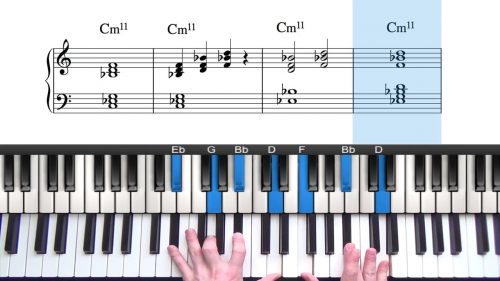
We can also achieve some really interesting sounds by applying upper structure triad theory to both major and minor c...
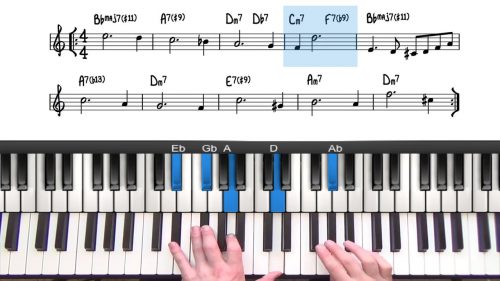
Upper structure triads are complex sounding altered dominant chords. They will add texture and sophistication to your...
Practice Tips
-
This arrangement contains some great examples of 13sus chords moving to altered dominants and also incorporating tritone movement.
-
If you like any of these sus voicings and progressions, try transposing them into different keys.
-
Remember to always think in terms of numbers and scale degrees.
- This is the best way to truly absorb a concept.


In the second measure (G7) you mentioned and played that chord as a G minor. Is the score wrong? That confused me a bit. Both chords sound fine but I’m leaning towards the major sound rather than having two minor chords next to each other so to speak.
Hi Ron,
Please excuse my late reply here.
Yes the G7 on the lead sheet seems to be a mistake. I believe this score will have been copied directly from the Real Book and there is often variety in the chords and harmony when comparing the same song different Real Books and even sometimes between versions of the same Real Book.
In this case, both G7 and G-7 work with the melody note in that bar, but I would go further with the following analysis and research:
Interestingly, I checked the chord chart for this tune in iRealPro App (which is a great reference point for this kind of stuff by the way) and I see that it shows E-7b5 and A7 in bar 2. For me, that actually makes more sense harmonically, as it creates a full 251 into D minor in bar 3. I have attached a screenshot of the iRealPro chart below for your reference.
The iRealPro App is a more modern/recent resource than many Real Books, and generally speaking the chord changes are more accurate. This tutorial was one of the earlier tutorials I made for PianoGroove and at that point I was not checking/comparing multiple sources for the chord charts. Please excuse my oversight there!
As I say above, both G-7 and G7 work, but after seeing the E-7b5 and A7 in the iRealPro chart, I would certainly lean more towards G-7 than G7, as G-7 and E-7b5 are closely related, ie. if we play E-7b5 and put the root E on top, we then have G-6 (G-Bb-D-E).
One final consideration would be the tempo that we play the song at. In this tutorial we are arranging the tune as a ballad and so the E-7b5 and A7 works well. If we were playing the song at a very fast tempo, it could be a better option to play G-7 in bar 2.
So in summary, I would recommend to play either G-7 as I play in the lesson, or E-7b5 and A7 as shown in the iRealPro chart.
I will correct the notation to show G-7 instead of G7 to avoid any confusion.
If you have any follow up questions just let me know.
Cheers,
Hayden
Thank you for the detailed answer which includes the reason for the chord and the chords to replace the G-7. That greatly helps
My pleasure, Ron.
I’m glad it’s helpful.
If you have any other questions don’t hesitate to get in touch!
Cheers,
Hayden