


Major 251 Improvisation
In this approach to improvisation that we are exploring, the major 25 is the most important thing to learn. You must learn the major 25 voicings thoroughly in all 12 keys as it is the basis of all the latter harmonic concepts.
If you skip this step, it will make the contents of this course much harder to understand, practice, and internalise.
Take The Melody Over All 12 Major 251s
Before we start to use the chosen melody as a tool for improvising, you must play through all 12 keys with simple voicings. It might take a moment to get through the keys, but it is essential at this point that you learn the melody well and get fast at playing it in any key called.
Completing the above steps will help you visualise the melody in every key, and it will help you to play the melody quickly and effortlessly as we explore more advanced applications.
Apply The Melody To “There Will Never Be Another You”
Once we have learned the melody well over the 25s in all 12 major keys, it is now time to apply the melody to the chord progression of the tune “There Will Never Be Another You”.
If you have completed the last step as directed, you should be familiar with the melody in all 12 keys, making it easy to apply this knowledge to the chords in the form of the tune.
Transpose The Tune Into All 12 Keys
As mentioned in the earlier lesson, you should strive to be able to play the song in every key. This will deepen your understanding of harmony and take you forward as a jazz musician.
We will now go through the tune in another key, which of course would be preferable to do in all 12 keys! As an example, we will transpose the tune and the melody into the key of Db.
Next Steps: The Minor 251 Progression
Spend some time to thoroughly learn the melody in all 12 major keys. This forms the foundation on which we are going to build. Once this has been internalised, we are ready to move onto the next part of this course which will bring you more options while improvising and deepen your understanding of harmony.
Related Lessons

251 progressions are essential components of the jazz language and so taking the time to memorise them will greatly b...
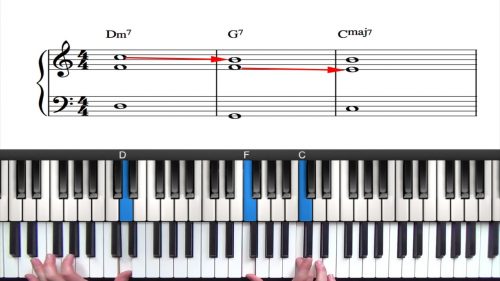
Most jazz standards that you come across will contain a 251 progression in some form so it is essential that you know...

Rootless voicings sound more professional than root based 7th chords and they voice lead much more smoothly in a 251 ...
Practice Tips
-
If you are unable to play the major 251 progression in all 12 keys, you must learn it thoroughly before continuing.
-
Check out the related lesson section above for major 251-focused tutorials.
-
The next step is to play the melody over all 12 major 251s. This task is easier if you have memorised the melody in terms of scale degrees of the underlying harmony.
-
As an exercise, find different ways to resolve the melody, see the examples in this video for inspiration.
-
Finally we demonstrate how to play the given melody over every 251 in the tune. Repeat this exercise yourself.


This lesson does not give much in the way of practice tips. Further many of the licks the instructor is playing in between the 251’s are distracting and really just intimidated me.
Hi Vadim,
It might be nice to check out our Improvisation & Transcription exercises:
pianogroove.com/licks-lines/
Transcribe one of the lines and then try to follow the process that Tuomo outlines.
The main point of this course is to understand how much ‘mileage’ we can get from a simple melody line. The task for the student is to transcribe a line and repeat the process instead of copying Tuomo’s demonstrations.
Cheers,
Hayden
I find that Tuomo sometimes takes for granted that students can easily follow his suggestions, but in this case the general principle of applying the melody to various 2-5s and 2-5-1s in all keys is really useful and worth going back over the lesson until you get what he is telling you.
I am trying to number the notes so when I transcribed to a different key, I’ll know where I am at, but I don’t know whether to for example, in a D Minor seventh use a 1357 of the D minor or take the key that it’s in and this case see and use 2468 in other words do you number the notes of the chord scale that you’re in D Minor Or, G7 Or, C major or you just number the notes of the key that you’re in?
Hi John,
Great question!
When transposing a melody to a different key, always think in terms of the numerics of the individual chords in the 251 progression, not the key itself.
For the D-7 example that you outline, you would certainly think 1-3-5-7 of Dminor7 as these tones will most likely be part of the melody over the D-7 chord. We would not think 2468 of the key of C major, that would be extremely confusing, for me at least.
I always think 1-2-3-4-5-6-7 of the chord, and sometimes we might have different tones, for example the b5 over a -7b5 chord, or the alterations b9/#9/#11/b13 over dominant chords etc… but I’m always thinking of the melody notes in relation to the underlying chord, not the underlying key centre.
Another tip would be to identify and memorise the transition points between the chords. For example, when a melody line moves from the 2 to the 5 chord, often it will be via the guide tones (7th of the 2 chord into the 3rd of the 5 chord) either directly, or via an enclosure or approach pattern.
Similarly, when the V chord resolves to the 1 chord, melody lines typically resolve into chord tones (1-3-5-7) as these are strong landing points, and again enclosures and approach patterns are very common. The presence of the guide tones in improvised lines is what ‘keeps our melodies in sync’ with the underlying harmony.
Does that answer your question? Please let me know if you’d like me to explain further.
Best,
Hayden
I hosted a seminar on bebop enclosures for beginners in January which you might find interesting: pianogroove.com/live-seminars/bebop-enclosures-approach-patterns/
Thanks