


"Fly Me to the Moon" Harmonic Analysis
Welcome to the third lesson in our exploration of the tune "Fly Me to the Moon". This lesson departs from our previous focus on chord voicings and we now examine the key of the song and analyse the diatonic 7th chords in the key of C Major:

After this lesson you will have a better understanding of how jazz standards are composed using the chords and common chord progressions that exist within the key of C Major.
Numeric Harmony & Chord Progressions
Our exploration includes a thorough analysis of the tune’s chord progressions, highlighting the 2-5-1 progression which is the most common progression found in jazz music. We also introduce the 36251 progression which is an extended version of the 251 progression:
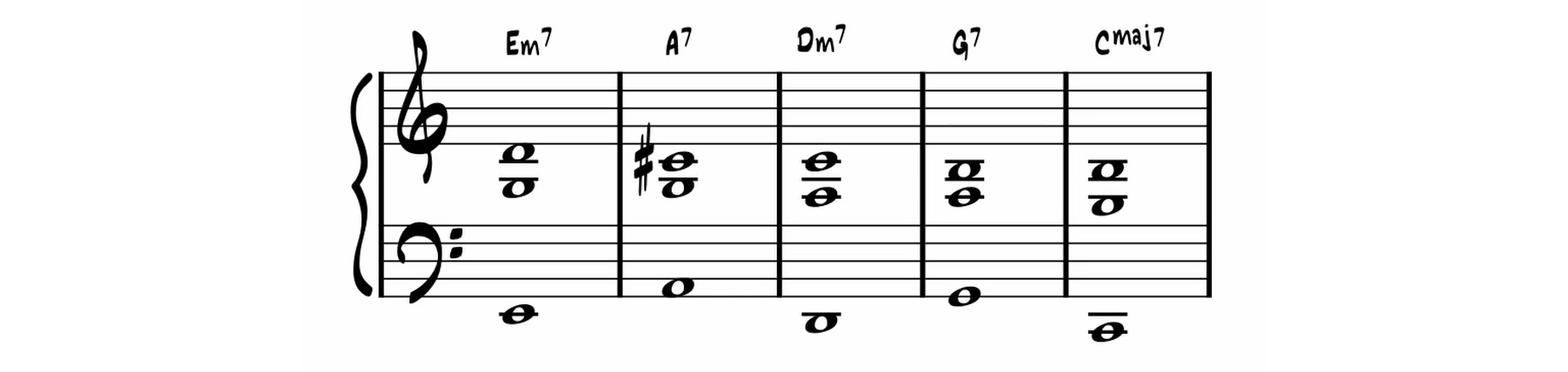
We then identify the other harmonic components such as the movement to the IV chord Fmaj7, and the use of the 251 progression in the relative minor key which is A minor.
The Relative Major & Minor Keys
Our analysis reveals the interplay between the relative major and minor keys within the tune "Fly Me To The Moon" and we highlight the shift between these ‘tonal centres’.

Shifting tonal centres and modulations are one of the hallmarks of jazz standards and this will become clearer as you extend your repertoire in the upcoming courses.
10th Intervals & Harmonising The Melody
In our next lesson we will arrange the song with left-hand 10th intervals, melody harmonisation techniques, and we will discuss the role of the turnaround phrase.
Related Lessons
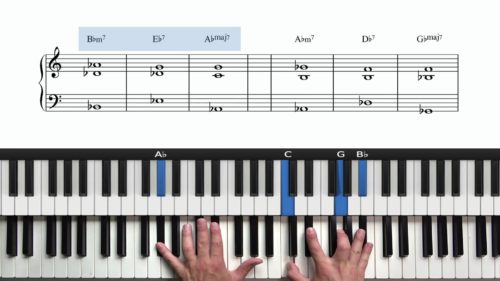
We introduce the concept of whole-step 251 drills, and how they can be an interesting alternative to drills around th...
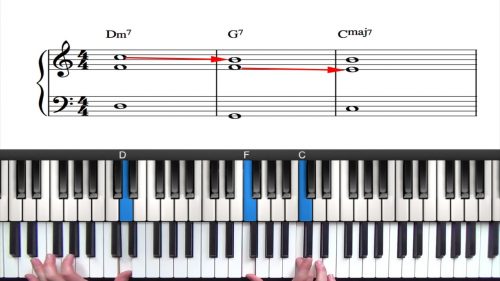
Most jazz standards that you come across will contain a 251 progression in some form so it is essential that you know...
Scales provide the basis for understanding harmony. Learning and memorising the 12 major scales is the first step in ...
Practice Tips
-
Memorise Major & Relative Minor Scale Pairs: Familiarise yourself with the C major scale and its relative minor - the A minor scale. The relative minor always starts and ends on the 6th note of the major scale.
-
Identify 2-5-1 Progressions: Create a habit of identifying 2-5-1 progressions on lead sheets. Annotate your lead sheets with a pencil to jog your memory whilst playing the tunes.
- Learn The Diatonic 7th Chords: Remember that the diatonic 7th chords are the same quality in every key. The I and IV chords are major 7ths, the ii, iii, and vi chords are minor 7th chords, the V chord is a dominant 7th chord, and the vii chord is a minor 7b5 chord.


Hi Hayden,
I like your courses very much even though for my level they are quite difficult. My question is now. I ofte don’t find the next course. After “Fly me to the moon” Harmonic Analyses you say that we explore in the next lesson more but I do not know what is the next lesson. Can you help me please.
Best
Gerold
Hi Gerold,
I’m glad that you are enjoying the lessons. I’m currently working on new “Novice” level courses which are the most accessible courses and arrangements on the website.
I realised I still need to need to add a final lesson to this course which is melodic embellishment for the tune ‘Fly Me To The Moon’ – I will record that lesson this week.
In the interim, I recommend that you get started with the other “Novice” course which you can find here: https://pianogroove.com/jazz-piano-lessons/reading-lead-sheets-bb-major/
This course contains 9 lessons which cover 2 beginner jazz standards which are ‘My Foolish Heart’ and ‘Autumn Leaves’ and so I recommend to get started with these lessons immediately.
Please check out the course page above and let me know if I can be of further assistance.
Talk soon,
Hayden
Thank you Hayden
Hi, I’ve been enjoyng this course a lot, but like Geromino I’d like to watch the final lesson on Fly me To The Moon but couldn”t find it. I suppose it’s not available yet. When will it be available? Thanks 🙂
Hi Luiz,
Thanks for the message. I still need to record this lesson – my apologies it slipped off my radar – so I will get to work on it immediately. Please give me a few days and I will ensure it recorded, edited and added to the course.
In the interim, we do have some more advanced lessons on this tune which you can find here: https://pianogroove.com/jazz-piano-lessons/fly-me-to-the-moon-tutorial/ – this incorporates more advanced theory but it might be interesting for you to watch.
Also feel free to get started on the other Novice level courses, and I will finish this courses asap. Definitely by the end of the week! :–)
Talk soon,
Hayden
Hi Luiz,
The final lesson has been added to the course page. Here is a direct link:
https://pianogroove.com/jazz-piano-lessons/10th-intervals-melodic-tips/
I am also going to add a “Listening & Transcription” module to each of our Novice courses where we listen to a selection of recordings of the songs that we cover, and I’ll explain how to emulate melodic embellishments, fills, and other ways that we can make our arrangements unique and personalised.
More on that to follow shortly.
Best,
Hayden
Hi,
I really like your lessons. Eventhough I think I am a bit more advanced I also want to go through the novice course to not miss something I otherwise did not come across. Just a small feedback regarding the notation around 13:30. It should be symboled as D9 instead of Dm9 since you are notating and playing F sharp and not F. Eventhough this is of minor importance, I thought I should mention it as it might lead to confusion for other beginners.
Hi Henning,
Thanks for the comments.
You brought up a very good point about the chord progression. Specifically, the D-7 or D-9 is the minor 2 chord in a 2-5-1 progression or in this case the 2 chord in a 3-6-2-5-1 progression.
In our upcoming courses, we explore how the 2 chord can be voiced either as a minor chord or as a dominant chord. In this instance, I am changing the chord quality from minor to dominant. Although the chord is spelled as D-9, we have the freedom to play the chord as a D9 (D dominant 9th) voicing.
I agree that this could be clearer in the tutorial as I don’t specifically explain this. I will add some text to explain that I am changing the chord quality from minor to dominant.
Always keep in mind that in diatonic harmony, such as 2-5-1s or 3-6-2-5-1 progressions, we have the freedom to convert minor chords into dominant 7th chords. This opens up more choice and variety for voicing options.
I explain this in more detail in the following courses which I recommend you check out next:
https://www.pianogroove.com/jazz-piano-lessons/cocktail-improvisation-for-beginners/
https://www.pianogroove.com/blues-piano-lessons/bluesy-stride-piano-beginners/
Please let me know if I can be of further assistance and enjoy the lessons!
Cheers,
Hayden
Hi Hayden, loving the lessons and courses on here.
Something I’ve noticed here and in other lessons is that sometimes a chord is marked as a 7th chord but you omit the 7th note completely when playing.
For example and ~8:20 on this lesson, on bar 9 the chord is Dm7, but you don’t play the 7th (C).
It does sound good without it, but I’m wondering if you had any advice on why that works/when that is appropriate?
Hi Andrew 👋
Great question and I’m glad to hear you are enjoying the lessons!
For the bar that are referring to (bar 9 demonstrated around 8:20) the main reason that I omit the 7th is that the root of the chord (D) is the melody note.
Notice that “D” as our melody note is just a whole step above the 7th (C) which creates a dense ‘cluster’ of notes. To my ears this sounds a little too heavy. When the 7th is omitted it creates a cleaner sound – to my ears at least.
Another option would be to play the 7th an octave down in our left hand, but then we play a major 7th interval (D to C) in the lower register of the piano which sounds a little ‘muddy’ – as jazz musicians say.
These are the 2 reasons why I decided to omit the 7th.
——-
An important point is that we can always simplify a minor 7th chord to a minor triad, although most of the time it is not necessary to do so.
In this particular harmonic and melodic situation, it sounds better and cleaner to omit the 7th. The D minor triad still outlines the foundation of the harmony, and so the harmony that we are playing is still D minor, just a simpler version.
——–
To summarise:
– Often the scale degree of the melody note (the root of the chord in this case) can have implications on the voicing configuration. In this case the melody note (D) is very close to the major 7th (C) which creates a lot of ‘rub’ between the notes.
– The register of the melody note and the chord is also an important factor. If we were to move the melody note and our chord voicing 1 octave higher, then playing the root and 7th in the left hand does sound nice, because the 7th interval is not in the lower registers anymore.
– On a related note, when the left hand is in the lower registers, it’s often ‘safest’ to play root and 5th of the chord, as I do at at 8:20.
– The fifth interval can be played very low down on the piano without it sounding ‘muddy’ and ‘distorted’. The 7th interval cannot, which is why playing “D” and “C” (root and 7th) in the left hand in this register of the piano does not sound pleasing to the ear.
—–
It’s a great question Andrew, and it’s also wonderful that you are being inquisitive into why I omitted the 7th in that particular situation. I hope my explanations above are helpful.
From playing lots of jazz standards we gradually develop an appreciation for these little nuances relating to the register of the chords, harmony, and melody, and what are the most ‘optimal’ choices.
I guarantee that once you get 10 or so jazz standards under your belt, these kind of harmonic decisions and choices will become much more intuitive.
If you have any follow up questions just let me know.
Best,
Hayden
Thanks Hayden, that makes complete sense!