


"Autumn Leaves" – C Section
Welcome to the final lesson in our beginner exploration of the tune "Autumn Leaves". Having previously explored both the A and B sections of this classic jazz standard, we now turn our focus to the final 8-bar section of the song: the C section.
In this lesson you will learn the harmony and melody of the C section and then we will play through the song in its entirety to consolidate all of the lessons in this module.
C Section Melody
The C-section is the final 8 bars of the tune. This 8-bar section introduces a new melody which which clearly differentiates it from the A and B Sections. We begin by isolating the melody in our right hand and we pay attention to the the chromatic melody used to transition between the B and C sections.
C Section Harmony & Voicings
Next we isolate the harmony so that we can clearly visualise the chord progressions, voicing configurations, and the voice leading of 7ths falling to 3rds. Emphasis is placed on voicing configurations that create an even spread across both hands to create a balanced sound in our chord voicings.
Related Lessons
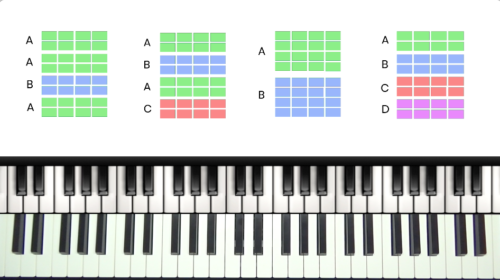
Lead sheets are a useful tool when starting out with jazz, but by learning tunes by memory, it will benefit your play...
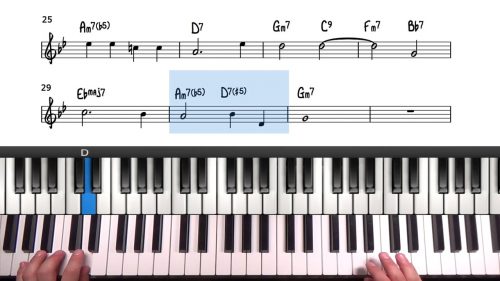
First we discuss how the melody is phrased when playing with a medium swing. We also look at the placement and syncop...
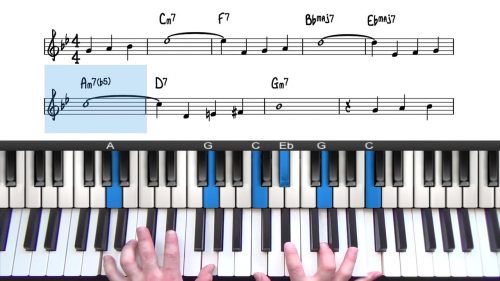
Usually played in the key of G Minor, the tune follows a 32 measure AABC form and contains both major and minor 251 p...
Practice Tips
-
Isolate common progressions: Begin by practicing the C-section’s unique harmonies in isolation before playing them in context of the tune.
-
Voicing configurations: Experiment with different voicing configurations to find the most balanced way to spread the notes across both hands.
-
Performance time: Once comfortable with the C section, you're ready to combine all of the sections as demonstrated towards the end of this lesson.
- Visualise the form: Develop a mental map of the song’s structure AABC. Dividing it into these manageable sections aids in memorisation and performance.


Melody embellishments coming up?
Hi Humberto,
Yes I will add another lesson to this course on melodic embellishment.
We do have a tutorial on Autumn Leaves here which covers melodic embellishments: https://pianogroove.com/jazz-piano-lessons/autumn-leaves-tutorial/
This lesson incorporates more advanced harmony and also scale runs and other melodic patterns that can be used when playing this tune as a ballad. Please check out that lesson.
Talk soon,
Hayden
Hi, Hayden, thanks for your reply.
I had already seen and gone through the other Autumn Leaves lesson you referenced with the more advanced harmony and melodic embellishments but wanted to see what you would include in this beginner course.
Although I am past the beginner level I have found the Lead Sheet Fundamentals courses to be extremely useful because they put together many important elements of jazz piano learning in one neat package.
They are a great way to review what I have learned in other lessons and also a great refresher for remembering songs I may not have played for a while.
Looking forward to more of these courses in the future and I recommend them highly to those just starting out.
My pleasure, Humberto.
Yes I imagined you had already found the other lesson on “Autumn Leaves” as I recorded that many years ago. My plan with this course is to demonstrate some simpler melodic embellishment ideas.
I’d like to add a lesson to each jazz standard in the Lead Sheet Fundamentals Learning Path where we listen to a selection of recordings and I explain how to pick thing from the recordings, such as little melodic embellishments and ways to rephrase the melody etc…
I think that would work better than simply showing a bunch of possible embellishments, because it would help students to see how fun and rewarding it can be to transcribe and emulate recordings, once that we have a basic arrangement in place.
That’s wonderful to hear.
On the website and in the community area, I recommend that new students set a goal to learn 10 to 20 tunes, but I realised that many of the jazz standard tutorials – even the ‘beginner’ ones – contain reharmonisations, substitutions, and other more complex theory which can be a little intimidating for new jazz piano students.
So the plan is that the Lead Sheet Fundamentals learning path will have 20 jazz standards that are simple, easy to learn, but at the same time very beautiful to play. That way we have a wide range of tunes in this section that help students to build out their repertoire as quickly as possible – which is the goal when starting out with jazz.
The Lead Sheet Fundamentals Learning Path currently contains 9 jazz standard studies and can be found here: https://www.pianogroove.com/syllabuses/lead-sheet-fundamentals/
It’s funny because sometimes ‘coming back to the basics’ is exactly what we need. It helps us to build stronger foundations which allows us to develop in other more advanced areas. I myself found it very useful to revisit some of these tunes with basic R-3-7 voicings, particularly “My Foolish Heart” which I hadn’t played often.
Once we have memorised a basic arrangement of a tune, we then have more freedom to move in other directions when playing it. As oppose to learning a very sophisticated arrangement by heart – which can sometimes be challenging to remember all of the intricate pieces.
More tunes will be added to the Lead Sheet Fundamentals learning path this month!
Talk soon,
Hayden
Hayden, that is great to hear.
Hi Hayden. In bar 28 you voice the chord as a Bb in the bass and D-Ab-D in the right hand. The melody has a G on the 3rd beat however you play the G on what seems to be beat 4 or 4and. I would normally think to put the G in the Bb7 voicing on beat 3. Sounds fine the way you do it. Just curious what you’re thinking there.
Greg
Hi Greg,
Apologies for the late reply here – I was doing some maintenance on this page and I noticed that I missed your comment and question.
In the section that you mention I am simply playing the melody more freely than what is written on the lead sheet. The melody live that we see written on the lead sheet is just a rough guide and we have the creative liberty to change the exact placement of the melody notes, add notes in, take notes away etc… of course within reason so that the melody is still recognisable.
For the section you mention, we can absolutely play the note G simultaneously with the Bb7 chord on beat 3, or as I demonstrated in the lesson I played the chord and then moved the melody to beat 4 of the bar. Both work fine.
If you listen to a handful of versions of this song on YouTube or Spotify you will hear that each musician interprets the melody differently and listening to recordings is a great way to discover new ways to phrase the melody of jazz standards.
I hope that helps and again please excuse my late reply here!
Any other questions just let me know.
Best,
Hayden
Thanks, Hayden. I was reading your reply to Humberto above about a ‘Novice’ section. When I click on ‘Lessons’ on the Dashboard the options are Beginner, Intermediate, and Advanced. Is there a Novice section somewhere on the site?
Greg
Hi Greg,
Thanks for getting in touch.
Yes we introduced a “Novice” category but then decided to move back to the previous Beginner/Intermediate/Advanced classification.
All of the beginner-focused tutorials that I’m discussing with Humberto can be found in this syllabus/learning path:
https://www.pianogroove.com/syllabuses/lead-sheet-fundamentals/
There are currently 4 courses which cover 9 jazz standards in this learning path.
Please let me know if I can help further.
Best,
Hayden
Hi Hayden,
I’ve been working through Autumn Leaves and really focusing on your spread voicings and relaxed solo style.
I’m coming from a background where I’ve practiced jazz swing with backing tracks and strict time, so I have a solid internal pulse. But I’m finding it difficult to transition into the more relaxed, rubato feel you use in your solo playing.
When I try to loosen up, it sometimes feels like I lose the pulse rather than intentionally stretching it.
Do you recommend a specific way to practice this transition? For example, should I stay aware of a steady internal tempo while delaying certain chords, or is there another approach you suggest for developing that feel?
Thank you. Really enjoying the lessons!
Hi Claire 👋
Great question and I’m glad to hear you are enjoying the lessons.
It’s actually quite a difficult question to answer as I don’t really think about this too much when I’m playing ballads in a solo piano context.
Here are a couple of ideas to play around with:
1) Start by playing with the melody placement and phrasing:
I find that if I play the melody more relaxed and more rubato, it’s easier for me to follow that with the harmony. For example, instead of playing the melody exactly how it’s written on the lead sheet, we can play around with the duration of the notes so that the melody line is a little freer. I’m still trying to keep the same amount of time in each bar, but giving some notes a little more time and some less.
If you listen to vocal versions of jazz standards you will hear that vocalists do this naturally. The vocalist might come in late with the melody line, and then speed it up so that it still fits in the bar, for example.
We can also embellish the melody by adding notes and other decorations such as turns and grace notes, and this can help to ‘stretch’ and ‘pull’ on the time as we are adding more notes.
2) Accentuate the rests in the melody
This tune has a lot of resting melody notes, for example in bars 1, 3, 5, and 7. Try adding a little bit more of a delay in those places, and then when the melody becomes more active in the next bar, play that a little faster. This creates a ‘pull and push’ dynamic where we are intentionally slowing down and intentionally speeding up.
When delaying the melody at the rest points, this is easier to do when we are playing more sophisticated harmony such as chord alterations over the dominant chords as it’s very nice to let those textures and colors ‘ring out’.
Experiment with those 2 ideas and let me know if it helps.
If anything else springs to mind I will post it here for you.
—-
I think it’s great by the way that you have worked on your swing and strict-time playing with backing tracks. It’s a very important skill for jazz piano and something that I have to work extra hard on as I naturally play a little freer. Also this song is usually performed in-tempo and at fast speeds, so it can feel a little unnatural to play it freely.
—–
Who we listen to is also important…
When I was starting to learn jazz piano, I was listening to a YouTube musician named Pianista Italiano. You can find his channel here: https://www.youtube.com/@AlfonsoGugliucci/videos – and he has a version of Autumn Leaves here: https://www.youtube.com/watch?v=AO32dVF6fgo
He plays much freer than I do, but I like his playing style. It’s relaxing and nice background music.
Above anything else, I feel that listening to a playing style that you like, and then trying to play along and emulate it, is the best way to absorb it. That takes more time and patience, but something to keep in mind too.
Please let me know if you have any further questions Claire, and enjoy the lessons!
Best,
Hayden
Hi Hayden,
Thank you so much for your detailed reply. It’s very helpful!
I’ve been experimenting with your ideas and also singing the melody in my head while I play, which has helped me with the phrasing and timing. I’m beginning to feel the push and pull concept more clearly, but it will take a lot more practice. That’s ok, I’m not giving up!
I really admire your playing style and I’m enjoying learning from your approach. Thanks again for taking the time to explain!
Clare
Also, will you be adding the lesson on melodic embellishments? I’m very interested in learning about that!
Thanks again!
Echoing Clare’s question on melodic embellishments that you reference in the course, but there is no other section. Should we just go to the more advance course on Autumn Leaves (but that has advanced harmony?
Hi Seth,
Please excuse for my late reply.
I have just replied to Claire’s question in detail with some recommendations. Please take a read through that response and the suggested resources.
As mentioned in my response to Claire, I had planned to show some melodic embellishments in this course but when I came to record it I realised it’s quite difficult to do when using 2-handed spread voicings.
This tune is usually performed at faster tempos in which case we use rootless left hand voicings or walking bass lines. Both of these approaches free up the right hand for melodic embellishment – I shared some links to relevant lessons in my response to Claire.
So yes to answer your question, I would recommend checking out some of the more advanced lessons on this song to further develop it from a melodic standpoint.
I will amend my narration at the end of this lesson to avoid confusion with regards to looking for the melodic embellishment lesson that doesn’t exist in this course.
On a related note, I am working on some new up-tempo improvisation courses and this tune will certainly be included so look out for updates in the forum.
Cheers,
Hayden
Hi Claire,
Please excuse my late reply here.
I had originally planned to include a lesson on melodic embellishment but then realised that when playing this song as a ballad with basic R-3-7 spread voicings, the melodic embellishment possibilities are quite limited.
I hosted a seminar in February where we explored spread voicings, stride voicings, and shell voicings. You can find that seminar here: https://www.pianogroove.com/live-seminars/jazz-piano-fingering-for-beginners/
We explore how shell voicings are usually the best choice when we want to add melodic embellishments. This is because shell voicings contain the essential elements of the harmony (R-3-7 or sometimes R-7) which frees up our right hand completely to embellish the melody. I explain more in this seminar about – please watch from around 17 minutes to 35 minutes for a deeper exploration of this.
—–
We have a ballad tutorial on Autumn Leaves which includes fills and runs which are a form of melodic embellishment, you can find that tutorial here: https://www.pianogroove.com/jazz-piano-lessons/autumn-leaves-tutorial/ – that’s worth checking out.
I also covered “Autumn Leaves” with a basic walking bass and rephrased the melody. Again this is similar in some ways to using shell voicings because I demonstrate a simple walking bass line using roots, 5ths, and passing tones which frees up the right hand. You can find that tutorial here:
https://www.pianogroove.com/jazz-piano-lessons/autumn-leaves-bass-line-2/ – please watch from the 3rd chapter “Phrasing” – I give a demonstration of changing the melody and then explain my thought process behind it.
A few extra tips for this are:
1) Pay attention to where the melody rests, ie. the long notes held in the melody. Try to keep these resting point ‘intact’ but approach them differently. Think chromatic approach, enclosures, adding grace notes is also very effective.
2) Play the same melody notes written on the lead sheet, but change the phrasing.
3) Listen to lots of versions of the song. This is perhaps the most important tip that I could give you. If you listen to 10 different versions of this song on Spotify or YouTube, I’m sure that each player/performer will phrase and embellish the melody differently. Create a playlist with the versions that you like and listen to them, study them, and play along with them.
Here’s a little playlist that I created on Spotify: https://open.spotify.com/playlist/3VT2Bau1YkDMGmQ7DPda39?si=c3137f38882f418e
You can search on Spotify and then filter by playlists to find playlists that other people have created, here’s another one for example: https://open.spotify.com/playlist/2N6xVUMqsiCgDehmXGXj83?si=4b799484236748ec
—-
Also check out the penultimate chapter of my most recent seminar: https://www.pianogroove.com/live-seminars/it-could-happen-to-you-arrangement/ – where we talk about targeting the chord tones. This is very important and ties into my point above about paying attention to where the melody rests (becuase the melody often rests on chord tones).
—-
I hope that helps Claire, please check out the above lesson references and let me know if I can help further.
Cheers,
Hayden
Hi Hayden,
I really appreciate the thorough response and all the helpful explanations, tips, and links you included. Melodic embellishment is a relatively new concept for me, so I’m looking forward to working through everything and starting to apply it to Autumn Leaves and other tunes.
Thanks again!
Clare
My pleasure, Claire.
If you have any follow up questions don’t hesitate to get in touch.
Cheers,
Hayden