


Triad Based Improv Drills
In this blues improvisation lesson we cover a series of drills and exercises to help you develop improvised melodic ideas using triads.
It’s crucial to understand that while our ideas are based on triad shapes, we’re not confined to these notes exclusively. This approach allows for the inclusion of chromatic notes to create more interesting triad-based melodic lines.
Chord Tones & Target Tones
We begin with the F7 chord, examining the notes of the triad (F, A, and C) and exploring the chromatic possibilities within. We start with simple one-bar phrases and practice the same idea over all three chords in the basic 12-bar blues progression in F.
For example, targeting the 3rd of the F7 chord, moving up to the 5th, and then chromatically descending to the 9th, always while visualising the triad shape and considering the chromatic pathways that exist within.
Enclosures & Approach Patterns
An important aspect of this lesson is the introduction of enclosures, a technique where dissonant notes are used to enhance the resolution to a more stable tone or resting place. This concept is applied to all 3 chords of the 12-bar blues form, emphasizing the importance of maintaining a solid groove in the left hand, even when incorporating more complex right-hand techniques.
Lesson Downloads
-
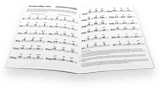 Triad Improvisation Drills File Type: pdf
Related Lessons
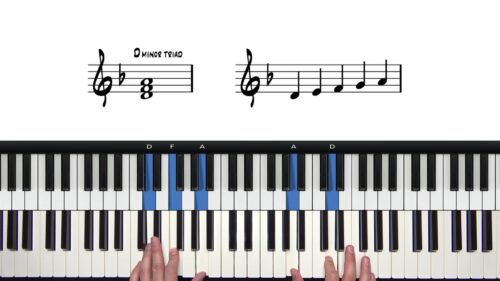
It’s important to understand that ‘improvising using triad shapes’ doesn’t mean that we have to exclusively p...
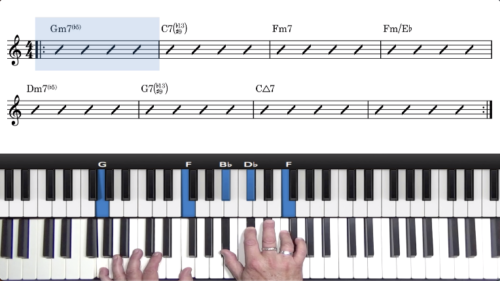
In this 5 minute masterclass we will explore how we can use triads as a way to create improvised melodies and whole i...
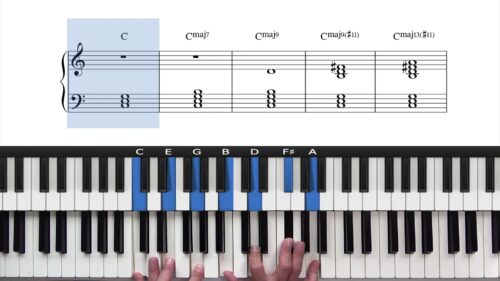
The triad is the basic building block for many different types of chords. The 4 types of triads are major, minor, dim...
Practice Tips
-
The triad lines are meant to sound like an exercises at this stage. The goal is to build strong foundations in triad-based melodies before introducing the 6th and 7th in the next lesson.
-
Begin by familiarizing yourself with the basic triad shapes for each chord in the 12-bar blues progression in F. Play these triads in different positions and registers on the piano.
-
Experiment with adding chromatic notes within these triad shapes to understand how they can enhance your melodic lines.
-
Start with one-bar phrases for each chord. Focus on targeting specific notes like the third, fifth, and ninth of the chord.
-
Practice pulling and pushing the timing of your phrases. Experiment with holding certain notes longer and playing others quicker to create different rhythmic feels.
- Integrate the triad ideas with the space fillers we covered in the previous modules learned. We explore this further in the next lessons of this module.


How do you count theses riffs?
Hi Rick 👋
When I’m playing the slow blues style I am always feeling/counting a 12/8 pulse.
1-2-3-1-2-3-1-2-3-1-2-3
or
1-&-a-2-&-a-3-&-a-4-&-a-
I have attached a graphic below showing how this subdivision is applied to the phrase.
The tricky part is ‘the turn’ and how this fits into the counting.
You can try removing the turn (which happens on the ‘2’ of the 2nd and 4th group of triplets)
ie: 1-2-3-1-2-3-1-2-3-1-2-3
and that makes it much easier to count.
By playing through the form many times whilst counting/verbalising the 12/8 pulse, this underlying pulse will become engrained within you.
This helped me to become more flexible with my timing and allows me to ‘pull and push’ on the exact note durations of my melodies whilst staying locked into the underlying groove.
On a related note, I’m almost finished recording the new “Slow Blues Substitutions & Improv” course which uses the key of C.
I’ve found that by introducing chord substitutions into the blues, it creates a lot more melodic possibilities which has really ‘opened doors’ for me in terms of creating more interesting and varied improvisation in this style.
Keep an eye in the forum for updates as the new lessons will be ready in the next couple of weeks.
Talk soon,
Hayden
Hello Hayden,
shall we remove any shuffle temptation from these drills? Sometimes it comes naturaly in the fingers…
j.
Hi Jérôme,
Great question!
I think it’s a great idea to play shuffle patterns with these drills.
It is a slightly different style of playing the blues compared to what I outline in this course, but the underlying rhythmic framework is the same and based on triplet 8th notes.
It can be nice to switch between the 2 style of left hand. Perhaps start with the style that I demonstrate in this course for a chorus of 2, and then move into a chorus with left hand shuffle patterns. That can be a nice way to ‘pick up the energy’ and also add more variety between the choruses.
Have you also seen the slow blues course in C? You can find that here: pianogroove.com/blues-piano-lessons/slow-blues-in-c-harmony-improv/ – this one has a stronger focus on reharmonisation and chord substitution.
Finally here is a seminar with some improvisation concepts for the slow blues in C: pianogroove.com/live-seminars/slow-blues-piano-improvisation/ – I think you will also enjoy that session.
I hope that helps Jérôme – and please let me know if you have any other questions.
Cheers,
Hayden